paper seasons
a book about connecting dots

scroll
for everyone who took the long way round
and found it was the only way
that made any sense
Once, when I was very young, my mother asked me to do a thing — what it was is of no consequence now, but it was of the absolute biggest consequence to little Rebekah at the time. She was rather solidly in the camp of thinking that the thing she'd been asked to do was a complete, irrevocable waste of her precious time.
"Why?" little Rebekah asked. "Because I said so," said her mother. "But why do I have to do it because you said so?" little Rebekah asked, more musing than rebellious. "Stop asking questions," said her mother, in the way that mothers do. "…but why…" mumbled little Rebekah.
It really wasn't defiance; it was more a kind of itch. The feeling that behind every answer was a door, and behind every door was another question, and behind that was something worth finding.
Little Rebekah did the thing, eventually, with a kind of resolute it-doesn't-matter-anyway-ness. But she kept the question.
i've been thinking about this: the best marketing i've ever experienced didn't feel like marketing at all. it felt like being known.
not in a "i see you know what i like because you've been tracking the things i added to cart last week" way, but in a "oh, you actually get it and exactly what about it i love and you've also seen all the best tiktoks" way. the way a good friend buys you a gift you didn't know you wanted but immediately can't live without — because they know you, and because they care, and were paying attention the whole time.
most marketing is someone shouting about themselves in a crowded room, and trying to say it the way they think you want to hear it.
now the good stuff — that's someone sitting next to you and just being themselves. saying exactly the right thing, almost accidentally.
i think that's what i've been chasing all my life. not the selling, the knowing.
i think the most interesting people are the ones who notice what was already there, and want to translate it in their own special way — put a bit of themselves into it, and put it back into the world.
a songwriter hears a rhythm in a conversation. a designer sees the grid in a city skyline. a therapist catches the word you keep circling back to without realising.
it's the same muscle every time: pattern recognition. the willingness to look at two things that seem unrelated and ask, quietly, what if they're not?
everything rhymes if you look long enough. the trick is knowing which rhymes matter to you.
The questions didn't stop as she grew up and started working, as people tend to do – they just changed clothes.
In advertising, the question was: why would anyone care about this?
She learned to find the answer — or, more often, to build one from nothing, or back-engineer an answer from a product. She learned that attention is a kind of trust, and that most people both don't deserve it, and also spend it really badly.
She got good at this. Suspiciously good, maybe, for someone who was moderately convinced that the things she was selling didn't matter.
But the asking mattered. She was sure of that.
Then came a data company — eight and a half years of it — and the question became quieter, more patient: why are people searching for this? What are they actually trying to find?
Search, it turned out, was a form of listening. Every query was a small confession: I don't know. I need help. I'm looking for something I can't quite name. She liked sitting with that. She liked the honesty of it.
Somewhere in the middle of all this, she trained as a counsellor. She was at a point in her life where she was searching for meaning, and something about the work she was already doing kept pointing her towards that room — the one where someone says one thing and means another, and the most useful thing you can do is notice what's in between and guide them along that gap.
i built websites when i was twelve. they were terrible, but oh i loved them so much. tables inside tables, frames that didn't scroll properly, poorly sliced images, guestbooks, fireworks exploding when you click your mouse. they were also, i think, some of the most creative things i've ever made — because i had absolutely no idea what i was doing and that meant everything was possible.
twenty years later, i'm learning again. the languages are different, the tools are unrecognisable, and i am — objectively, measurably — a complete beginner.
it's wonderful.
there's this thing that happens when you've been good at what you do for a while. you forget what it feels like to not know. you forget the specific texture of staring at something that makes no sense and knowing that the only way through is through. you get efficient. you get competent. you lose something.
being bad at this is getting it back, and i love it.
There is a particular kind of conversation you can only have with yourself on a train, or in the shower, or at 2am when your cat has just barfed and you can't get back to sleep after panic-scrubbing and wondering why you'd ever thought to purchase a cream-coloured carpet.
It goes something like this:
What am I actually doing?
Not the LinkedIn job description; the real thing. The thing underneath.
She'd spent years asking "why" on behalf of other people — why customers click, why readers stay, why a particular sentence lands and another doesn't. She was good at it. She liked it, it was fun and made her feel productive and stuff. But at some point the question turned around and looked at her.
Why you, though? Why do you care so much about the space between what people say and what they mean?
And she didn't have a tidy answer, but she had a collection of moments.
A mother who said "stop asking questions" — which was, in its own way, the most formative answer she'd ever received.
A decade of sitting inside other peoples' search queries, learning that everyone is looking for something, and most people can't say exactly what.
An assortment of friends whose words conveyed one thing, but whose actions always proved otherwise.
A counselling classroom where she realised that the skill she'd been using to sell things was the same skill you use to help someone feel heard.
A bunch of failed romantic relationships with no conclusions; just open-ended questions.
A screen full of design patterns that were really just frozen conversations — someone asking a question, someone else trying to answer it, over and over.
None of it was planned, but all of it was connected.
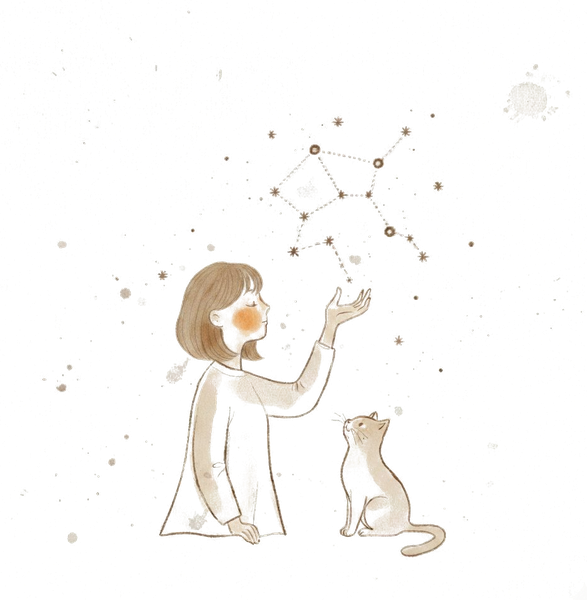
The dots don't make a straight line. They make something more like a constellation — you can only see the shape when you step back far enough, and even then, someone else might see a completely different picture.
But here's what she sees:
Everything she has ever done has been about the same thing: chasing that feeling of connectedness and deep-seated knowing of "ah, this is the truth" when you understand what someone actually needs, even when — especially when — they haven't said it yet.
every screen is a question someone is trying to answer.
i mean this literally. someone opens an app because they need something — to find, to fix, to feel, to finish. and the interface is the conversation that happens next. every button is a sentence. every empty state is a silence. every error message is a small betrayal of trust or a small repair of it, depending on how it's written.
i've been thinking about the space between what a product says and what a person hears. it's the same gap that exists in every conversation, every relationship, every piece of marketing — the distance between intention and reception. the friction between two things with different goals, trying to meet in the middle and love each other.
most days, i think this is the most interesting place to be. right in the middle, where the saying meets the hearing.
i should tell you something about this book.
i didn't write it alone.
i wrote it with an AI — and i don't mean that it checked my grammar or suggested a better word for "nice." i mean i opened a chat window and said "here's roughly what i'm thinking, and here's a raw first pass," and it came back with paragraphs that sounded uncomfortably like me – 80% me, but still not quite in a weird, hollow way.
and i felt two things at once: relief, because the shape of what i'd been trying to say was right there on the screen, and it had taken all of twenty seconds instead of the four hours it would have taken me to hand-roll.
and something else — a small, bruising thing — because if a machine can do this better than me, then what exactly is the part that's mine?
i asked it that, actually.
i said, "i almost feel like you write better than me."
to which it said: i write faster. that's not the same thing.
which is exactly what a machine trained on the entire internet would say, and also, extremely annoyingly, probably (hopefully?) true.
here's what i've landed on, at least for now: i chose the voice. i chose the direction. i chose the story. i chose the frame. i chose what to cut, what to keep, what to add, and what to rewrite by hand. and then i chose to do it all again.
when it wrote something that was almost-right, i knew it was almost-right, and i knew what was wrong, and i fixed it.
when it got something wrong about my own thoughts, i felt it immediately — the way you'd feel an impossibly wrong note in a favorite song.
the machine is a very, very good mirror, but a mirror doesn't know what it's reflecting. it doesn't know why the fireworks-on-mouse-click matters, and it doesn't know that "more musing than rebellious" is the whole point.
it doesn't feel the itch.
i think the itch is the part that's mine.
i don't know what it means to write and create in 2026, and i don't actually think anyone does yet. but i do think that sitting with this discomfort instead of resolving it, and asking the tool "why" while using the tool — feels like a natural next step for a person who has never once in her life been able to stop asking questions.
so: i made this together with a machine.
the words are partly mine but also partly not, and i'm not going to pretend otherwise. but the ideas, and the feelings, and the why — the reason any of it exists, the thing underneath the thing — that was always mine, and it still is, and will always be.